
Modern industrial machines often require simple and reliable control using minimal hardware. One common requirement is to start and stop a motor using a single push button instead of separate Start and Stop buttons.
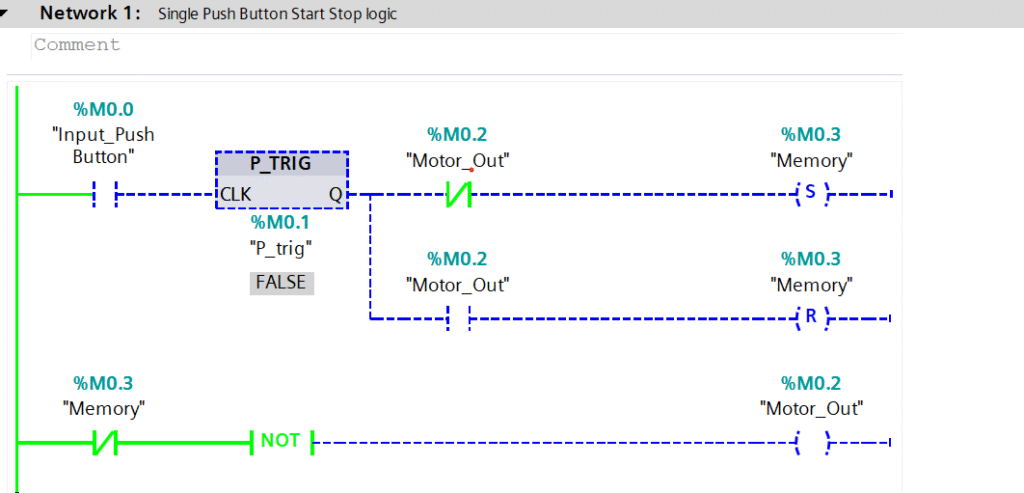
This article explains a Single Push Button Start–Stop PLC logic using edge detection (P_TRIG) and memory bits, as shown in the ladder diagram below.
Why Use Single Push Button Logic?
Using one push button instead of two provides several advantages:
- Reduced wiring and panel space
- Lower hardware cost
- Simple operator interaction
- Cleaner logic using memory bits
Each press of the button toggles the motor state:
- First press → Motor ON
- Second press → Motor OFF
Overview of the Logic
This ladder program uses:
- Positive edge detection (P_TRIG)
- Set / Reset (SR) memory logic
- Internal memory bits (%M)
| Address | Name | Description |
|---|---|---|
%M0.0 | Input_Push_Button | Physical push button input |
%M0.1 | P_trig | Positive edge trigger |
%M0.2 | Motor_Out | Motor output control |
%M0.3 | Memory | Toggle memory bit |
How the Logic Works (Step by Step)
1. Push Button Edge Detection
The push button is connected to a P_TRIG (Positive Trigger) block.
- The P_TRIG detects only the rising edge (OFF → ON)
- Prevents repeated toggling while the button is held
- Ensures one action per press
2. Toggle Logic Using Memory Bit
When the button is pressed:
- If the motor is OFF, the memory bit
%M0.3is SET - If the motor is ON, the memory bit
%M0.3is RESET
This is achieved using:
- SET coil (S) when motor is OFF
- RESET coil (R) when motor is ON
This effectively creates a toggle behavior.
3. Motor Output Control
The final network controls the motor output:
- The motor output
%M0.2follows the inverse state of the memory bit - When memory is ON → Motor ON
- When memory is OFF → Motor OFF
This separation improves clarity and troubleshooting.
Sequence of Operation
| Button Press | Memory Bit | Motor State |
|---|---|---|
| Initial | OFF | OFF |
| 1st Press | ON | ON |
| 2nd Press | OFF | OFF |
| 3rd Press | ON | ON |
Advantages of This Logic
✅ Prevents button bouncing issues
✅ Safe and predictable behavior
✅ Easy to expand (interlocks, alarms, timers)
✅ Works well in Siemens TIA Portal and similar PLCs
Applications
This logic is commonly used in:
- Conveyors
- Pumps
- Fans
- Small machines
- Manual override controls